As student engagement is falling nationally, Peabody Veterans Memorial High School has found a way to encourage learning and participation, and even spark an interest for some students.
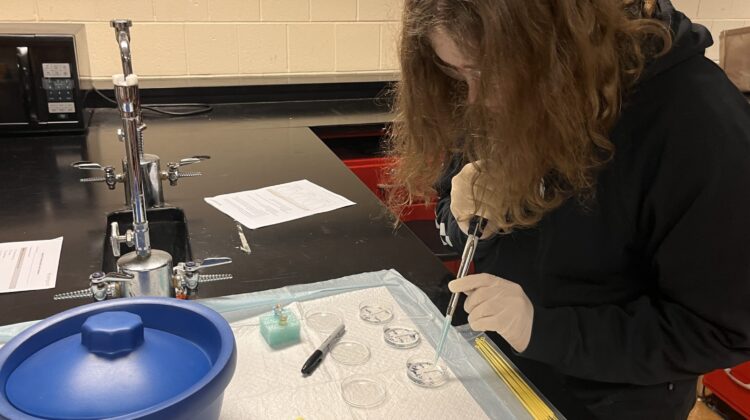
PVMHS, in partnership with Springpoint and the Barr Foundation, has implemented a Transformative Learning Experience (TLE) program, “Honors Biotechnology Applications,” taught by Ryan Slater.
Springpoint is a nonprofit organization that reimagines the high school experience by centering students. It has served more than 8,000 students, 70 schools, and 230 teachers nationally.
“We hear adults have very high expectations for what they want kids to graduate being able to do. And then we hear kids say that their current experience was mind-numbingly boring. And not only were the kids disengaged and didn’t understand why they were being asked to do what they were asked to do, but also kids just felt like they were being treated like they were dumb because they were doing worksheets in the 11th grade,” Springpoint Executive Director Elina Alayeva said.
Alayeva added, “We wanted kids to have access to the kind of learning that they knew that they were capable of, and (that) adults wanted to have kids experience in order to both boost engagement, but also boost rigor so that they would graduate prepared and (with) all the things the adults wanted… So we developed TLEs as a set of curricula to both build a vision for what learning could look like (for) all the stakeholders in the school, but also to get kids experiencing the kind of learning that would activate them to do the kind of rigorous thinking that we wanted kids to be doing.”
Jess Rose, senior program officer on the Education Team at the Barr Foundation, highlighted that the Barr Foundation’s education program focuses “on helping to transform the high school experience for young people across New England… so that it is like a life-altering experience: one that is both a good experience in the moment but also leads to outcomes and a world in which all young people have all doors open to them in their future — and this is especially true for students who’ve been historically and systemically marginalized.”
Rose said Springpoint is one of the Barr Foundation’s longest-standing partners, as well as its largest partner, with a nearly decade-long relationship. Springpoint is one of the Barr Foundation’s grantees, and Rose explained that Springpoint’s grant “is inclusive of lots of things, but including the development of the TLEs themselves and inclusive of the training that they continuously offer to schools.”
She added that the Barr Foundation offers free TLE training and development to its grantees, which includes Peabody Public Schools.
Slater, when asked if he would be interested in attending a TLE curriculum training, jumped on the opportunity.
“I’ll take any tools to be added into my tool kit here for teaching,” he said.
Something that stood out to Slater during his training was that he was able to engage with the person who designed the curriculum, Cole Entress.
“It definitely felt more, for lack of better words, like more of an intimate experience that I could hear from this person who designed the curriculum, and we get to talk about their decision-making while designing it,” Slater said.
He added, “I had grown sick of these curriculums that preached that they’re perfect, but Springpoint never preached that they were perfect.”
Slater said Entress impressed him by saying, “You know your students better than I do,” and encouraging Slater to “mine the gold” in the curriculum and skip anything that he felt wouldn’t resonate with his students.
“I’ve never had a curriculum introduce itself that way. It’s very humbling. So when I actually did start diving into it, I was pleasantly surprised to see that it was all gold,” he said.
Slater explained that the curriculum he is teaching is based on community engagement, and it can be centered in any community for students anywhere. For PVMHS students, they are able to take the concepts they learn in the classroom and apply them to Peabody.
For example, he said the students first discuss pollution before broadening that concept to see if “there are any pollutants that are specific to our community.” The class also dives into environmental justice, discussing how those pollutants wound up in Peabody.
“It really gives the students an opportunity to research where they live,” Slater said, noting that the class looks over FEMA maps, energy sector maps, and more to “get an idea of the history of our community.”
He added that this process has been eye-opening to students as they “develop this vested interest” in their community and the pollutants that are affecting it.
From there, the class has to find ways to address the issues.
“We find that the overarching issue with a lot of these pollutants is: They’re invisible to the naked eye. You can’t really tell that this pollutant is in the water, the air, or the soil just by looking at it,” Slater said.
This leads the class into discussing and developing bioindicators. Slater explained bioindicators the way he would to his students.
“The prefix ‘bio’ means life, and ‘indicator’ is something that’s like a signal or an alarm, so you’re basically making a living thing an alarm for the presence of something else,” he said.
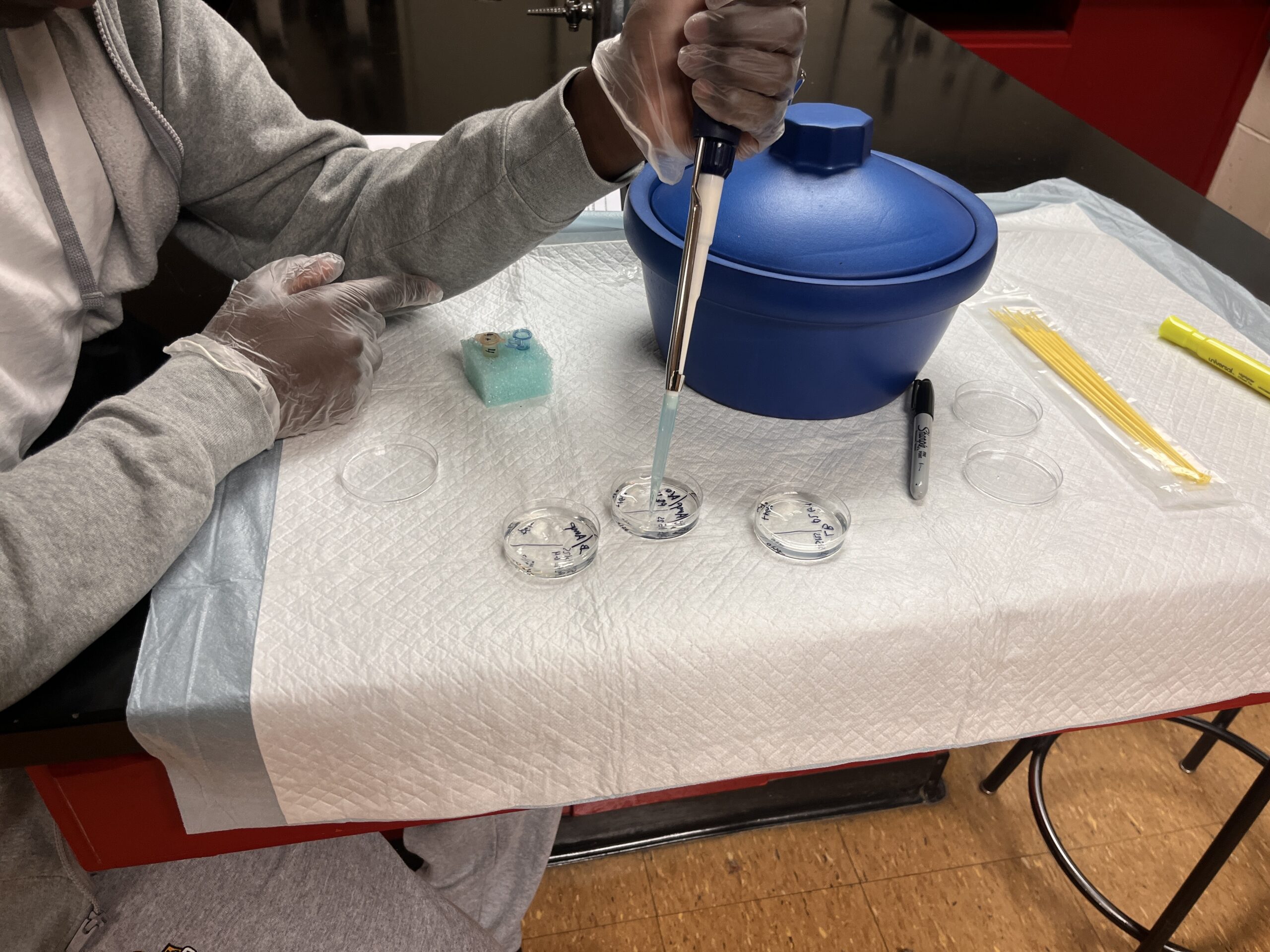
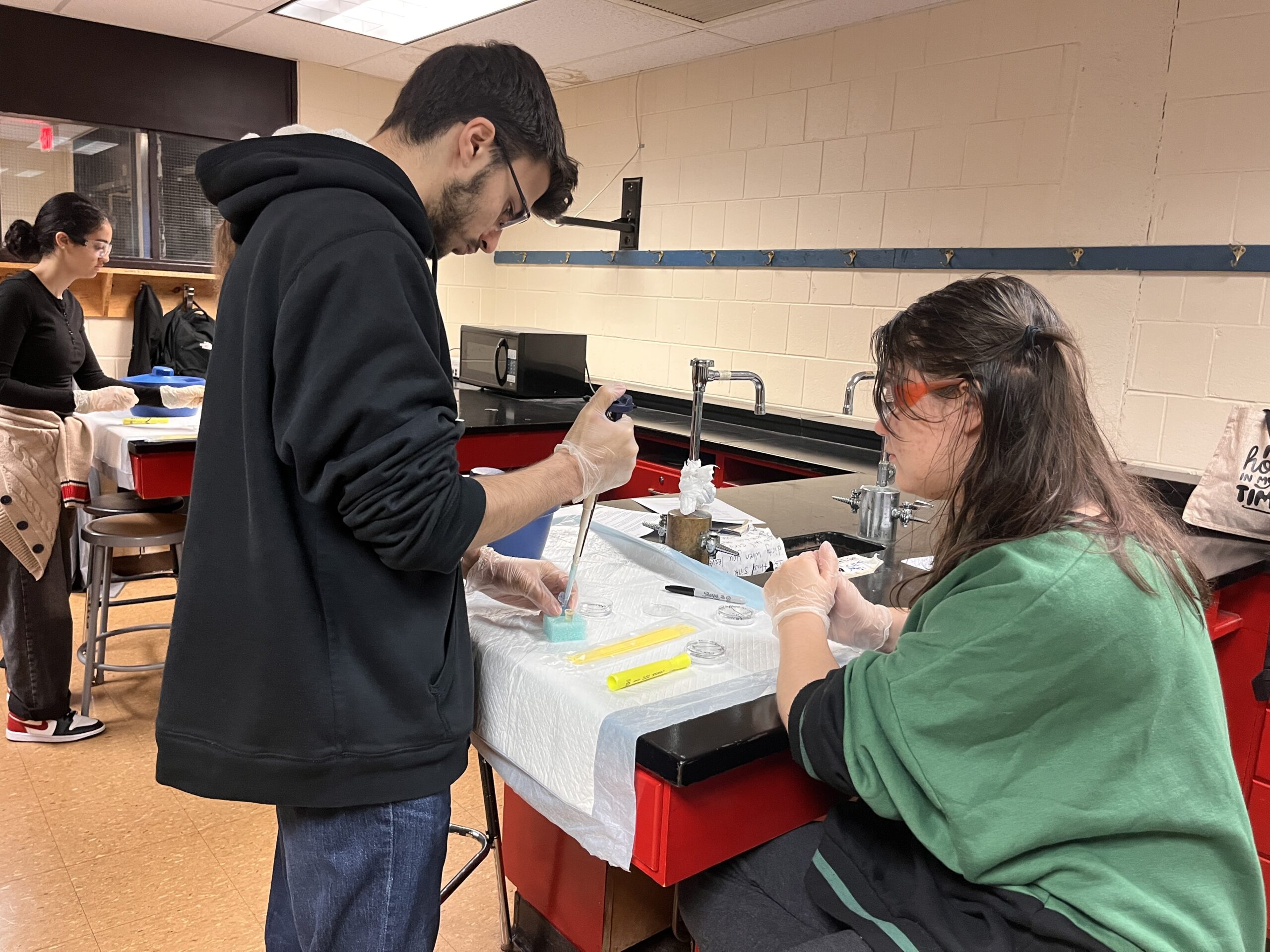
He continued, “The idea here is: Students would do some gene editing for E. coli bacteria and turn them into little alarms or little signals for the presence of a pollutant of their choosing.”
He said “what’s really cool” about this assignment is that the students can choose what pollutant is going to activate the alarm.
“Is it going to be the presence of arsenic? The presence of lead? The presence of copper? And how is the bacteria going to show that signal or make that alarm? Is it going to change color? Is it going to make a smell? Is it going to behave in a certain way to determine that the pollutant is in that spot?” Slater explained.
The next step for the class, Slater said, is to figure out “how can we take the biological mechanisms of one organism and introduce it into another?”
He said, “In the laboratory, we inject jellyfish bioluminescent plasmids to make E. coli glow. Now, this is just practicing the method. Bacteria don’t need the ability to glow… but it’s a great way to show success… and then taking those fundamental processes and extrapolating them into a scenario that fits the students’ pollutant of investigation.”
Slater said the students each design a plasmid and then write out a proposal to the community with an explanation of the experiment they would like to perform and their reasoning why. As an example, he said a student could propose using a bioindicator that turns bright green in the presence of lead to test the water in a pond that has a coal-burning plant nearby, which would increase the likelihood of lead contamination.
Slater’s students will be presenting their final work to the community on Thursday, May 21 in the Peabody Veterans Memorial Auditorium from 8:15-10:45 a.m. All community members are invited to attend.
“I think the beauty of this TLE is: It’s not just the science. It’s not just the fact-based (aspect). It’s very grounded in community involvement, community purpose,” he said. “And we’re not just solving an issue for a fictitious community somewhere else in the world, you know? This is home.
“And it really drives these students to come to school every day excited to look at a solution for their own community, and possibly a lake that they went fishing at once, or that’s down the street from them, and I really see students that maybe didn’t have the highest level of engagement earlier in the year really perk up and get excited when we reach this unit.”
Slater mentioned that some students in his class have expressed a desire to go into the biotech field because of this TLE. He added that while the TLE may be for biotech, it also comes with lessons in public speaking and communication, which is something the science community is struggling with right now.
“Professional scientists are often geniuses, yet they frequently struggle to share their ideas with the public. This gap in communication creates a barrier, unintentionally shutting out community members from the work happening in their own backyards. I believe this is where distrust in science begins,” Slater said. “In this class, we discuss that true mastery of a subject is the ability to summarize it into ‘bite-sized’ concepts accessible to all. If you truly understand a concept, you can make it accessible to everyone. That’s why our class’s concluding presentation to the community is open to everyone — from biotech experts to those who’ve never heard the term. Communicating the work is just as important as the work itself, and the community deserves a seat at the table.”
Slater first incorporated the six to eight week TLE into his classroom during the second semester of the 2024-25 school year, and he hopes to continue for many years to come.
“As of right now, in biotech, we were looking for cutting edge, innovative lesson plans that really pushed students with high rigor but also purpose, and this TLE, I can’t stress enough that it fit that need that we were looking for,” Slater said.